
Ensure (EAA) European Accessibility Act Compliance: The Enterpristore Ecommerce Platform Advantage
For businesses selling products or services in the European Union, a critical deadline is fast approaching: June 28, 2025. By this date, many digital products and services, including e-commerce platforms and websites, must comply with the European Accessibility Act (EAA). Ensuring your online store is accessible is not just good customer service; it is a legal mandate with significant implications for market access and potential penalties.
Navigating EAA compliance and translating legal requirements into technical implementation can be complex. The Enterpristore Ecommerce Platform is designed to provide a robust foundation and comprehensive solutions to help you meet and exceed EAA standards, ensuring your business is ready before the deadline. It combines platform architecture, accessibility consulting, and practical remediation services.
This compliance guide explains the key obligations, the role of WCAG conformance, and how Enterpristore supports equal access for users with disabilities. This article outlines the compliance path from legal context to technical action.
What Is the European Accessibility Act (EAA)?
The European Accessibility Act, Directive (EU) 2019/882, is an EU directive aimed at improving the internal market by removing and preventing barriers to the free movement of accessible products and services. The directive supports equal access across Europe and reduces fragmented rules.
Its goal is to make everyday products and services more accessible to people with disabilities and the elderly across all EU member states. It sets minimum accessibility requirements for specific products and services, including e-commerce, websites, mobile applications, e-book reading systems, interactive computing equipment, and payment terminals. These categories overlap with many everyday online customer journeys.
For digital teams, the EAA is closely connected to web accessibility and the EU Web Accessibility Directive, creating a stronger expectation of inclusive design across Europe. This alignment means an accessible website often serves both EU and broader inclusion goals.
Who Must Meet EAA Standards? Organisation and Organizations
The EAA applies to organisations and organizations that meet two conditions. First, they must have 10 or more employees or annual turnover above €2 million. Smaller businesses may still face accessibility expectations under other laws or contracts.
Second, they must sell products or services to consumers in the EU, whether based inside or outside the union. If your business sells relevant digital services to EU customers and meets the size criteria, your platform must satisfy EAA standards by the deadline. The location of your company does not remove the need for EAA compliance.
Who Must Meet EAA Standards? Organisation and Organizations
The EAA applies to organisations and organizations that meet two conditions. First, they must have 10 or more employees or annual turnover above €2 million. Smaller businesses may still face accessibility expectations under other laws or contracts.
Second, they must sell products or services to consumers in the EU, whether based inside or outside the union. If your business sells relevant digital services to EU customers and meets the size criteria, your platform must satisfy EAA standards by the deadline. The location of your company does not remove the need for EAA compliance.
Key Requirements and WCAG Conformance for Digital Services
The EAA mandates compliance with technical accessibility requirements. The primary standard referenced for websites and mobile applications is EN 301 549, which aligns closely with WCAG 2.1 Level AA. EN 301 549 provides a detailed framework that procurement teams and developers can test against.
Aligning EAA Requirements with WCAG and the EU Web Accessibility Directive
To meet European Accessibility Act requirements, organisations should align their digital content with the web content accessibility guidelines (WCAG), the EU Web Accessibility Directive, and recognised accessibility standards. These guidelines help identify accessibility gaps and define the technical requirements needed before the EAA deadline. By applying these standards to every digital content asset, teams can close accessibility gaps, strengthen EAA compliance, and deliver accessible experiences across Europe.
To meet EAA requirements for an e-commerce website, digital services must satisfy WCAG 2.1 Level AA criteria. This means content and interfaces should be perceivable, operable, understandable, and robust for all users. Each principle translates into concrete checks for code, content, and user interaction.
Businesses must also provide accessibility information about products and services, implement accessibility features, and ensure customer support is accessible. These obligations make accessibility a continuous compliance work stream, not a one-time project. Documentation of decisions, tests, and fixes helps demonstrate serious compliance work.
Common Accessibility Issues and Barriers in E-Commerce
Common accessibility issues include missing text alternatives for images, insufficient color contrast, unclear focus indicators, and forms that cannot be completed with a keyboard. These barriers can stop users with disabilities from browsing, selecting, and purchasing products. These barriers are common accessibility issues that affect both usability and legal compliance.
Other accessibility problems involve dynamic content, carousels, pop-ups, CAPTCHA challenges, and checkout flows that time out too quickly. Such issues often remain hidden until an audit or a website accessibility checker reviews the digital assets. Fixing them early reduces risk and improves the experience for every visitor.
Addressing these accessibility issues requires semantic markup, keyboard testing, screen reader testing, and careful content design. It also requires attention to PDFs, documents, videos, and other digital assets that customers may encounter. A strong content process prevents inaccessible PDFs and media from being published.
Why the June 28, 2025 Deadline Matters
The June 28, 2025 deadline is a critical milestone for businesses selling in the EU. It marks the date by which many products and services must comply with the EAA, including e-commerce platforms and related digital services. After that date, EU market access may depend on demonstrable accessibility.
Preparing before the deadline reduces legal risk, avoids rushed remediation, and helps your organisation build accessibility into procurement, design, development, and content workflows. Early planning also spreads costs and avoids emergency remediation across teams.
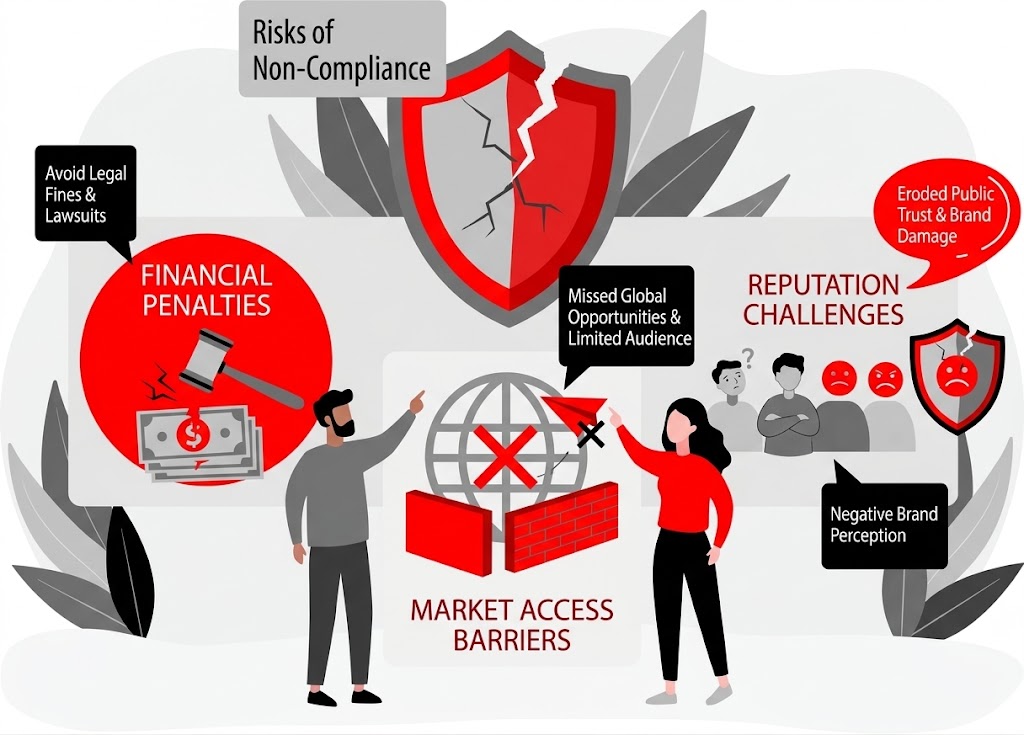
Risks of Non-Compliance: Penalties, Market Barriers, and Reputation Challenges
Ignoring the EAA creates legal penalties, market barriers, and reputation challenges. Non-compliance may lead to fines, enforcement actions, court orders, or restrictions on selling relevant products and services in EU markets. These outcomes can affect revenue, operations, and stakeholder confidence.
Regulatory authorities in member states can require corrective action, and businesses may face costly retrofits after the deadline. Legal action by individuals or organizations can also force urgent compliance work. Regulatory authorities may also publish enforcement decisions that attract public attention.
An inaccessible platform also excludes a major market segment, limits revenue, and damages trust. Demonstrating social responsibility through accessible design strengthens brand reputation and customer loyalty. Accessibility therefore connects directly to social responsibility and long-term brand value.
Enterpristore: Your Partner in EAA Compliance
Enterpristore is developed with a strong focus on accessibility. It provides a powerful, reliable solution to help your business meet and exceed EAA compliance requirements aligned with WCAG 2.1 Level AA standards. Our platform helps teams reduce risk while improving user experience.
We offer an end-to-end approach with source code level compliance, expert guidance, and ongoing support. This helps you create digital experiences that are accessible to everyone, not only to meet legal minimums. This partnership model supports organizations at every stage of maturity.
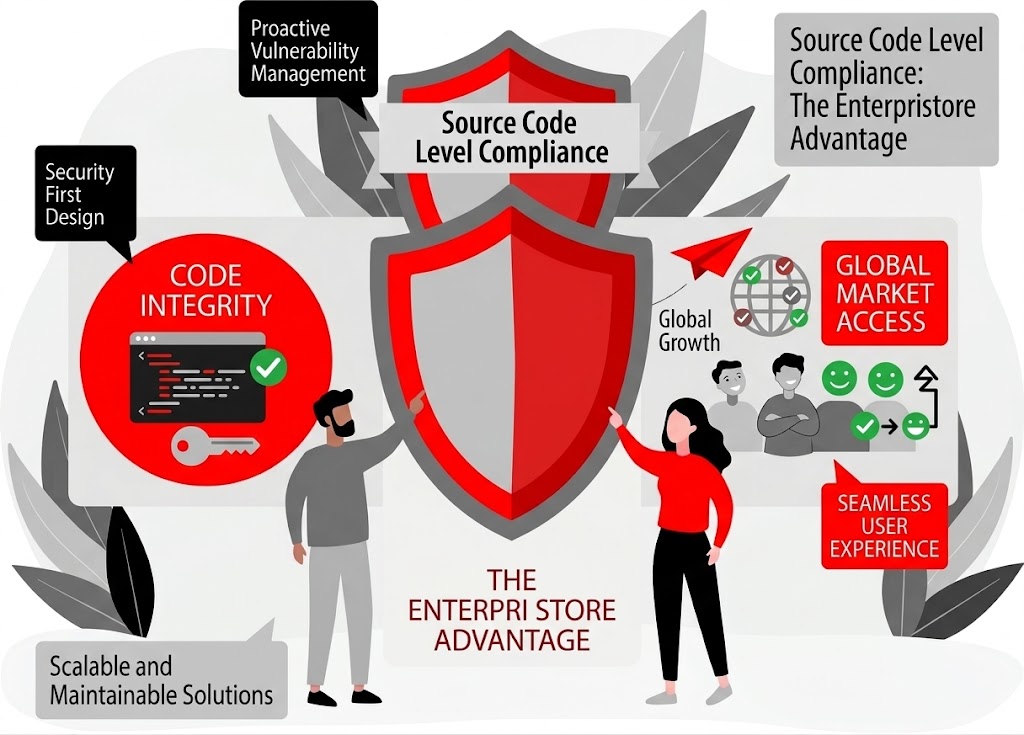
Source Code Level Compliance: The Enterpristore Advantage
True digital accessibility must be built into the foundation, not applied as a superficial fix. Many solutions use overlays or plugins that attempt to address issues after the fact. Overlays cannot repair semantics, missing labels, or broken keyboard flows.
These overlays may offer limited improvements, but they often do not guarantee full compliance, can break easily, and may not interact correctly with all assistive technologies. Enterpristore prioritizes source code level compliance instead. Source code work creates durable accessibility, not temporary patches.
This includes semantic HTML5, full keyboard navigation, appropriate ARIA attributes, sufficient color contrast, clear focus indicators, and responsive design. These foundations support stable, reliable, and sustainable WCAG standards conformance.
Comprehensive Accessibility Support and Audits
Beyond accessible architecture, Enterpristore offers expert guidance and audits. Our team can help configure your site for optimal accessibility and identify remaining gaps in custom content or configurations.
We can support accessible content by advising on product descriptions, images, videos, and documents. We also offer file remediation for PDFs hosted on your site.
Maintaining compliance is ongoing. We provide continuous support to address new accessibility challenges as you update your site, add features, or publish new content.
Digital Assets, Documentation, Digital Accessibility, and Accessibility Statements
Digital assets such as images, videos, PDFs, forms, and downloadable documents must be created and maintained with accessibility in mind. Documentation should explain how to produce captions, alternative text, headings, and readable file structures.
An accessibility statement should describe your commitment, contact route, known limitations, and feedback process. This statement helps customers, auditors, and regulatory authorities understand your digital accessibility posture.
Accessibility Tools and a Practical Compliance Guide
Accessibility tools can help detect some issues, but no automated tool finds every barrier. A website accessibility checker is useful for scanning code, contrast, labels, and structure, yet manual testing remains essential.
A practical compliance guide should combine automated checks, expert audits, keyboard testing, screen reader testing, and user feedback. It should also define ownership, timelines, and evidence for compliance work.
Regular reviews reduce common accessibility issues and help teams correct accessibility problems before they reach customers. This approach supports continuous improvement rather than last-minute fixes.
Applicability to Scotland and England After Brexit
Although the United Kingdom, including Scotland and England, is no longer part of the EU, businesses that operate in the EU or provide services to EU citizens must still comply with EU regulations, including the EAA, to access the EU market.
Companies in Scotland and England that sell products or services to EU consumers are subject to EAA requirements. They must ensure their digital offerings provide equal access and meet applicable EAA standards.
Penalties for Non-Compliance with the EAA
Penalties for non-compliance vary by member state, but they can include fines, legal actions, reputational damage, restrictions on market access, and required remedial actions.
Authorities may require corrective work, and companies may face court orders requiring compliance. These consequences make early compliance work far less expensive than reacting after enforcement begins.
Domestic Legislation, Disabilities Act, and Equal Access
Scotland and England may also have domestic accessibility laws independent of the EAA. The UK Equality Act 2010, often discussed alongside disabilities act principles, mandates accessibility in various contexts.
These domestic laws may not fully align with the EAA, so businesses serving EU customers should review both frameworks. A clear accessibility statement and documented compliance efforts can support equal access across markets.
Take the Next Step Toward EAA Compliance
The June 28, 2025 deadline is a critical milestone for businesses selling in the EU. Ensuring your e-commerce platform is compliant is essential for legal reasons, market access, and reaching a wider customer base.
Enterpristore offers a powerful solution built with accessibility at its core. It provides source code level compliance and expert support to help you meet and exceed EAA requirements and WCAG 2.1 AA standards.
Ready to Make Your eCommerce Site Accessible to Everyone?
Do not leave your business vulnerable to costly lawsuits, lost revenue, and reputational damage. Choose a complete solution for WCAG 2.1 AA compliance and provide an exceptional online experience for all customers.
Explore WCAG 2.1 AA compliance with Enterpristore, learn how our ecommerce solution supports accessibility, request a demo, or contact us for a quotation. Make your ecommerce or WordPress site accessible to everyone.

Conclusion
In summary, while the EAA imposes penalties for non-compliance within EU member states, businesses in Scotland and England that operate in the EU must adhere to these regulations to avoid legal and financial repercussions. It’s essential for companies to stay informed about both EU and domestic accessibility requirements to ensure compliance.
Ready to Make Your eCommerce Site Truly Accessible and Inclusive?
Learn how our ecommerce solution ensures accessibility and meets industry standards
Request a demo to see how Equally AI enhances accessibility and user experience
Contact us today for a comprehensive quotation to make your ecommerce or WordPress site WCAG 2.1 compliant